
Sewer Line Lifespan Depends on Pipe Material
How often should a sewer line be replaced depends almost entirely on what it is made of. Plenty of Piscataway houses built before the 1970s still run on vitrified clay or cast iron. Clay handles soil well but cracks at the joints. Once the camera is in, you can usually spot the offset before you even see the root hanging through it.
Orangeburg is the outlier. It is tar-impregnated paper pipe, and Orangeburg pipe deforms into an oval long before other materials give up. I've seen it flattened to half its original height, with nothing growing through it at all. Just time and groundwater pressure did the work. PVC is what we install for replacement work across Middlesex County now. Honestly, it's the one material where age genuinely isn't a conversation yet. Age alone never forces our hand. Condition does.
- Clay or cast iron - commonly 50 to 80 years, often longer if joints stay tight
- Orangeburg - frequently failing inside 30 to 50 years, sometimes sooner
- PVC - 75 to 100 years when it is bedded and sloped correctly
Warning Signs a Sewer Line Is Near the End
The first clue is almost always the lowest drain in the house. A basement floor drain or a first-floor tub backs up while the upstairs fixtures still run fine. Then it happens again a month later. Repeat backups in the same spot are a pipe problem, not a clog problem. Nine times out of ten, the homeowner has already snaked it once themselves. It came back inside of three weeks.
Watch for several fixtures slowing at once. A single slow sink is a trap issue. Three slow drains point at the lateral. A toilet that gurgles when the washing machine empties is telling you the line cannot breathe. That gurgle is one of the more reliable tells I know. People usually mention it almost as an afterthought.
Smell matters too. Sewer odor in the yard, the basement or near the cleanout means waste is leaving the pipe somewhere. The CDC covers why that matters in its healthy water guidance. Outside, look for soggy patches, small sinkholes, or one stripe of grass greener than the rest. Mice and drain flies near the basement floor often arrive through a broken lateral. Find drain flies, and I'm already thinking about the camera before I ask a single question.
New Jersey Soil, Trees and Freeze Cycles Shorten Pipe Life
Roots are the main killer here. Mature maples and willows chase the moisture at a leaking clay joint. They slip in as a hair-thin thread, then swell until the pipe splits. Middlesex County soil runs clay-heavy in a lot of spots. It swells with a wet spring and shrinks in a dry August, and the pipe moves with it. On an older street with mature trees, that's the call I'm expecting before the truck even pulls up.
Winter adds its own damage. Freeze and thaw cycles lift shallow sections and pull joints apart a fraction at a time. We see it every spring thaw. It's almost always the same stretch of pipe near the surface that moves first.
Inside the pipe, grease is the slow problem. Cooking fat cools, hardens and grabs wipes and paper towels until a shelf of scale builds on the pipe wall. Above ground, driveway loads and street traffic press down on shallow laterals. That pressure keeps up until an old clay run cracks across the top. Once that crack opens, the grease shelf just gives the roots something to hold onto.
A Camera Inspection Tells You If Replacement Is Needed
We open the cleanout and push a camera down the lateral all the way to the city main. The screen shows what no guess can: cracks, offset joints, bellies holding water, root mass and scale buildup. A locator wand on the camera head marks the depth and path of the pipe in your yard. That detail saves everyone an argument later about where to dig.
That footage is what separates a two-foot spot repair from replacing the whole run. Nine times out of ten the trouble sits within fifteen feet of the curb. That is where the pipe is oldest and traffic loads are highest. Worth knowing before you dig, because people often assume the damage is under the house when it almost never is.
If you are buying an older Piscataway house, do this before closing. Always ask for the video file and a written summary, not just a verbal opinion at the truck. I've had buyers thank me for that insistence a year later, when a seller's quick patch didn't hold.
Choosing Between a Spot Repair and Full Replacement
One crack in a pipe that is otherwise round, sloped and clean usually needs a section repair and nothing more. We cut out the bad length and tie in new PVC. But several breaks along the run, a collapsed section, or any Orangeburg at all changes the call. Patching tar paper pipe rarely holds a season. I don't even offer it as an option anymore, once I see that dark fiber board on screen.
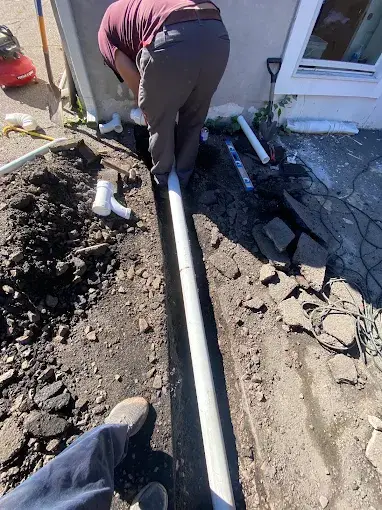
Where the soil cooperates and the line is reasonably straight, trenchless methods pull new pipe through the old path. That saves the driveway and the lawn, which matters a lot to people who just repaved. Open trench still wins on deep lines, full collapses and tight tie-ins at the main. No shortcut fixes a line that's folded in on itself.
Permits and a township inspection apply to this work in Middlesex County. We pull them before the shovel goes in. In most cases, the homeowner owns the lateral from the house out to the main. That surprises people every single time I mention it.
Habits That Keep a Sewer Line Working Longer
Most of what shortens a lateral is avoidable. Flush toilet paper and waste only. Flushable wipes are not, and we pull rafts of them out of old cast iron constantly. They tangle with hair and grease into something closer to a net than anything you'd call a clog. Scrape pan grease into the trash and wipe the pan before it hits the sink.
Outside, plant new trees well clear of the known lateral path. Once the camera marks it, you know where not to dig. On clay or cast iron, a camera check every few years catches a root thread while it is still small. That's the cheapest repair you'll ever make on this line.
Keep an accessible cleanout, and add one if the house never had it. It turns a messy emergency into a straightforward job. Small root intrusions are cheap to cut back. Left alone, they catch paper and grease. They become the backup that gets you at eleven at night with company in the house.
The Bottom Line
There is no fixed replacement schedule for a sewer line. Material, soil and roots decide it. Clay and cast iron under older Piscataway homes often run 50 to 80 years, PVC much longer, and Orangeburg far less. Repeat backups, several slow drains or a sewer smell outside are your cue to look inside the pipe with a camera. From there the footage decides between a section repair and full sewer replacement, and we walk you through both.
Not sure which one your line needs? Get a camera inspection first and let the footage make the call. Reach out to Edison Plumbing and Sewer, and we'll walk you through exactly what we see.