
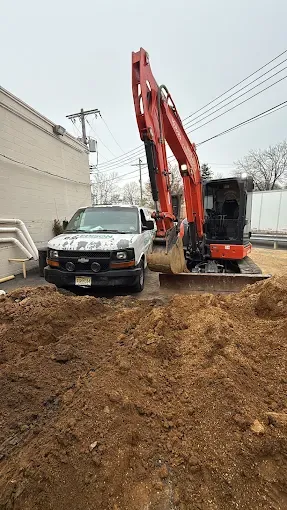
Signs Your Pipe Problem Needs Excavation
A backup that comes back again and again is the first red flag. Soft, wet patches in the lawn or a little sinkhole forming are the next. A sewer smell outside the house points the same direction. Here's one folks miss: a strip of grass that's greener and thicker than the rest. It runs in a straight line across the yard.
When every drain in the house backs up at once, that's not a sink problem — that's outside the house. We get a camera and a locator on it before anybody touches a shovel. That tells us if it's a collapse, a shifted joint, or roots that have squeezed the pipe shut. The clay soil around here holds water, so even a small leak turns the ground to soup fast. Sometimes a liner or a good cleaning is all it takes and nobody has to dig.
When Digging Is Not the Answer
Plenty of calls don't need a trench at all. Grease clogs, one sluggish fixture, a blocked vent — those get handled indoors. We'll tell you straight if that's your situation instead of talking you into a dig you don't need.
If the old pipe still holds a round shape, trenchless bursting or lining usually does the job. One bad stretch of pipe might just need a spot repair, not a full replacement. On the older homes we work in, the real problem is often the cast iron stack inside the house. It's not anything under the yard. Nine times out of ten, that iron is scaled down to half its opening. And whatever we put in the ground still has to sit below frost depth — trench or no trench.
How a Sewer or Water Line Dig Works
Here's the order we follow on every dig.
- 1. Mark-outs - we call NJ One Call and wait for the utility marks before a shovel moves.
- 2. Protection - plywood over the driveway and walk, with topsoil set aside in its own pile.
- 3. Trench and shore - we open the line and brace the walls per OSHA trenching and excavation rules.
- 4. Replace - out with the broken pipe, in with new, set on bedding stone.
- 5. Inspection - the township looks at the open trench before it closes.
- 6. Backfill - stone and soil go back in lifts and get compacted.
- 7. Restore - sod, concrete, or asphalt goes back, then a final camera pass.
Getting Your Piscataway, NJ Property Ready for Excavation Day
Clear the path before we show up. Move the cars, the trash cans, the patio furniture. That saves us a good hour of shuffling stuff around before we even break ground.
Public utility lines get marked free of charge. Private lines don't. Sprinkler heads, invisible fence wire, low-voltage lighting — flag those yourself, because we won't know they're there. We'll tell you when the water's getting shut off and about how long it'll be down. Plan your bathroom trips around that window.
Our mini excavator needs roughly a three-foot gate opening to get into the backyard. Tight side yards sometimes mean we're digging by hand instead. After a spring thaw or a hard rain, the ground around here turns soft and unstable. We may need to push the date back a day or two.
Excavation for Piscataway, NJ Homes and Businesses
Housing stock here is a mixed bag. Postwar capes, split levels, newer subdivisions, rentals packed in near the Rutgers campus. They all sit on the same stubborn ground. That ground is clay and silt. It drains slow and heaves with every freeze and thaw.
Under the older, bigger trees, we still dig up clay tile and Orangeburg pipe still in use. Orangeburg is basically tar paper shaped like a pipe, and once it goes oval, it's finished — no saving it. Permits and inspections run through Piscataway Township. There's a separate road opening permit if the work spills into the right-of-way. We cover excavation across Piscataway and out into Edison, Dunellen, and Middlesex too.
Excavation Cost in Piscataway, NJ
Depth and length of the run drive the price more than anything else. A long stretch from the house to the main means more trench, more spoil, more backfill. The deeper it goes, the more shoring it needs.
Soil plays into it too. Hit rock and the bucket slows way down. Hit groundwater and now we're pumping while we work. Obstacles add time on top of that — driveways, sidewalks, utility crossings. Thick tree roots that don't want to let go add more. Township permit fees and inspections are part of the cost. Add a road opening fee if the dig reaches the street.
Restoration is the last piece, and it's often the part people forget to budget for. Sod's cheap and easy. Concrete, pavers, and asphalt cost more to put back than they ever did to pull up in the first place.
A soft spot in the yard only gets worse once the rain sets in. Call Edison Plumbing and Sewer at (908) 417-3246 and we will camera the line before you commit to any digging. Same-day scheduling when the crew is open. Don't wait for the next backup.